


The Luxor Museum
Due to the many pharaonic discoveries in Luxor, they built the Luxor Museum, considered one of the most important Egyptian museums. It is in the center of Luxor ”Thebes” on the eastern banks of the Nile, almost halfway between Karnak Temple and Luxor Temple. The Museum has pharaonic objects, Islamic pieces from the Mamluk period, and Coptic fragments from the 5th century.
The History of the Establishment of the Luxor Museum
In 1962 the Egyptian Ministry of Culture hired the architect Mahmoud El-Hakim, who designed the Nubian Museum in Aswan, to construct the Museum. The Luxor Museum was built between 1972 and 1975 and opened to the public in December 1975. In 1989 statues were discovered in the courtyard of the Luxor Temple, so in 1991, a new room was added to the Luxor Museum (the first extension). It reopened on December 12, 1991, after a renovation. In the second extension in 2004, new rooms were added with the name ”Thebes Glory Hall” (Hall of the Glory of Thebes) that contains the monuments of the time when Thebes reached their maximum splendor.
The Construction of the Luxor Museum
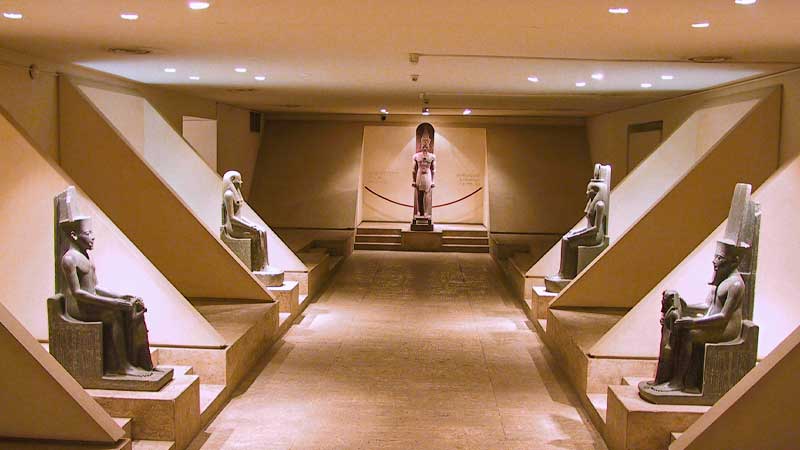
In front of the Museum are several statues in its garden, including two giant statues of Amenhotep III that were discovered in his mortuary temple. The Luxor Museum building consists of two floors that house statues, sarcophagi, vases, fragments, and many objects from various dynasties. Most exhibits are from the New and Middle Kingdoms buried in the tombs and temples in and around Thebes. In the second extension, new designs were made, and the lighting was changed to have a good effect on the dark gray of the walls.
The Important Exhibits at the Luxor Museum
Ground Floor of the Luxor Museum
Statues of Pharaoh Horemheb:
(18th dynasty) A diorite statue of the pharaoh sitting on his knees before the god Atum and another statue of the pharaoh before the god Amun.
Cobra Statue:
(25th Dynasty) A gray granite statue represents the god Amun-Ra-Kamutef.
Goddess Junit Statue:
(18th dynasty) A gray granite statue from the reign of Amenhotep III.
Statue of the Goddess Hathor:
(18th dynasty) A diorite statue from the reign of Amenhotep III.
Statue of Amenhotep III:
(18th dynasty) A red quartzite statue of the pharaoh at the foot.
First Floor of the Luxor Museum
• Entrance Hall:
Statue of the God Amun with the face of Tutankhamun: A limestone statue of the pharaoh carrying the amulet of Tit in his hands.
Statue of Amenhotep III:
(18th dynasty) is crowned by the god Amun placing his left hand on Amenhotep III, but Amen’s head is missing.
Amenhotep III Head:
(from the 18th dynasty), A red granite head. The head is wearing the white crown of Lower Egypt. The cobra is found on his forehead, and he has a false beard.
Sacred Cow Statue:
(18th dynasty) A head of cattle carved from a wood block represents the goddess Hathor. It was discovered in the tomb of Tutankhamun.
• Main room:
Head of Sestrosis III:
(from the XII dynasty), a pink granite statue has a cobra on its forehead, protruding ears, and natural lips. The cheekbones of the face are marked by lighting.
Mentuhotep Statue:
(11th Dynasty) A headless black granite statue in the pose of a scribe.
Statue of Amenemhat III:
(Dynasty XII) A black granite statue.
Pharaoh Tutankhamun’s Sphinx:
(18th dynasty) Calcite spent originally had human arms that held a vase as offerings.
Tutmosis III statue:
(18th dynasty), was found buried in the Karnak Temple. It is made of gray limestone with a slate.
Obelisk of Ramses III:
(19th Dynasty) A small red granite obelisk with hieroglyphics of Pharaoh Ramses III.
Statue of the god Sobek with Amenhotep III:
(18th dynasty) An Egyptian alabaster statue was discovered in the Temple of Sobek in the Kom Ombo Complex.
Statue of the God Amun and the Goddess Mut:
(19th dynasty) Two gray granite statues are sitting on the throne of Seti I.
• Hallway:
Mummies of Ramses I and Ahmose I:
They are the first two mummies exhibited to the public in Luxor, and they were discovered in the Deir Al Bahari.
• Room called “The Glory of Thebes”:
Statue of Thutmose III:
(18th dynasty) A diorite statue of the king seated on the throne was discovered in his mortuary temple.
Tutankhamun’s objects:
(18th dynasty) some of his objects found in his tomb in the Valley of the Kings, such as his chariot, bows, and arrows.
Statue of Amenhotep II:
(18th dynasty) A red granite statue wears the double crown of Upper and Lower Egypt.
Weapons of the New Kingdom:
Axes, ax blades, clubs, quivers, small wooden cow-pattern shields, arrows, spears, shields, and bows.
Ramses II Statue:
(19th dynasty) A red and gray granite statue of Ramses II wearing the double crown.
Statue of Seti I:
(19th dynasty) An alabaster statue of the pharaoh at the foot.
The second floor of the Luxor Museum
• Hallway
Statues of the goddess Sekhmet:
(goddess of power and strength) A statue of the head of the goddess with the sun disk, and another statue of gray granite.
Statue of Amenhotep (son of Hapu ) :
He was an architect; a gray granite statue was built in the Reign of Amenhotep III.
Officer statues:
From the reign of Amenhotep II, Thutmose IV, and Amenhotep III.
Ceremonial boat model:
(18th dynasty) found in the tomb of Amenhotep II in the Valley of the Kings.
• Main room:
Statue of Mentuhotep II:
(11th dynasty) A sandstone statue of the pharaoh in the form of the god Osiris.
Silver Treasure:
(Dynasty XII) from the reign of Amenemhat II.
Coins:
Silver coins from the Roman era, gold coins from the Byzantine era, and gold money are considered the oldest.
various heads;
Amenhotep I, Akhenaten, Thutmose III and others.
Statue of Ramses VI:
(20th Dynasty) A green slate statue was found at Karnak.
Sarcophagus model:
(22nd dynasty) the wooden coffin of a priest found in the Temple of Hatshepsut.
Findings from the excavations in the avenue of sphinxes:
Amulets in the form of the gods Sobek, Thot, Turris, eye of Udjat, scarab, necklaces, six candlesticks, and bowls of the Mamluk period were discovered on this processional path.
Several sarcophagi:
They are decorated with religious texts.
0 Comment