


Luxor Temple
The city of Luxor is famous for its temples because it was the ancient capital of the New Kingdom. One of the important temples is the Luxor Temple, which is located south of the Karnak Temple in the heart of the ancient capital of Thebes.
Luxor Temple is considered the second largest Temple in Egypt after Karnak Temple. The Luxor temple is notable for its colossal appearance. Amenophis III built the oldest building in the Temple, and the last was made by Alexander the Great.
The History Temple of Luxor
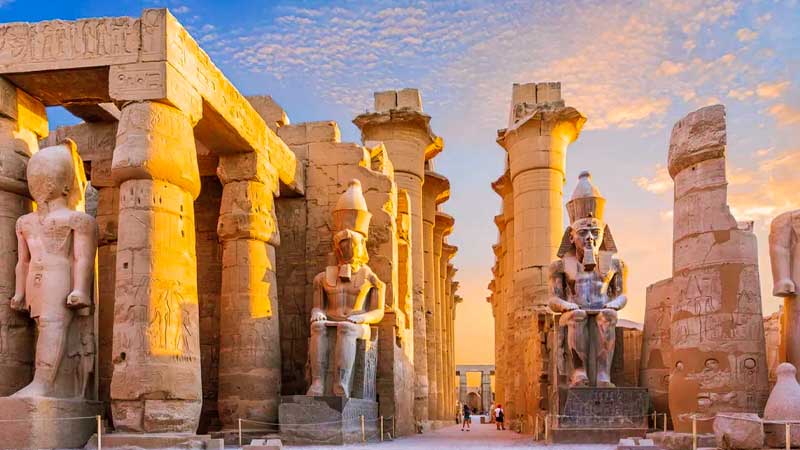
The Luxor Temple was called “Ipest-resit,” which means the women of the south (a reference to the wife of Amun, goddess Mut). It is said that on the site of the Luxor Temple was another temple dating back to the twelfth dynasty of the Middle Kingdom.
The Temple was built by order of Amenhotep III in 1400 BC (Dynasty XVIII) and is dedicated to the triad of ancient Thebes, Amun-Ra, his wife Mut, and his son Jon. Its architect was Amenhotep (the son of Hapu). The reconstruction of the Luxor Temple started in the period of Horemheb, Tutankhamon, and Ay, who finished the wall decorations and added columns and statues.
Queen Hatshepsut and King Tuthmosis III built a small building consisting of three dedicated rooms for the Theban Triad, and King Ramses II may rebuild these shrines and recorded his name on them. In the reign of Ramses II, some constructions were added, and Shabak later added new buildings, Nectanebo I, and the kings of the Ptolemaic dynasty.
Alejandro Mango renovated the Temple and added a chapel to the boat of the god of the Temple. In the Roman period, the Temple was a military center and camp, and later, the rooms were converted to churches by the Christians. Also, the Muslims built a mosque in 1244 AD. C. on the hypostyle hall of the Temple of Luxor.
Excavation at Luxor Temple
In 1885, excavation work began in this area of the Temple by the French Gastón Maspero. In 1990 one of the most important discoveries was found, 66 new statuary caches of the goddess Leona Sejmet that were transferred to the Luxor Museum.
Opet’s Feast at Temple of Luxor
The festival of Opet in ancient Egypt was a sacred occasion dedicated to Amun, the ram god of Thebes. On this festival, the Theban triad, consisting of the statues of Amun, their wife Mut, and their son Khonsu, left the Karnak Temple in a sacred boat for the south chapel of the Luxor Temple. This festival was in the second and third months of the flood season.
Construction of the Luxor Temple
The Temple is in the heart of Thebes. The Temple is 260 m long, 50 m wide, and 10 thousand m 2. The reliefs of the Luxor Temple depict scenes of religious ceremonies with gods, festivities, and victories of Ramses II. This Temple is connected to the Karnak Temple with an avenue of 365 human-headed sphinxes 3 m apart which Nectanebo I built.
In front of the entrance were two obelisks of Ramses II, but currently, there is one on the left measuring 25 m high, and the other was moved to the Place de la Concorde in Paris, France, in 1833. The entrance to the Temple is a tower built by Ramses II where there are red granite statues of Ramses II, two seated on the throne (originally there were four statues) and one on foot (there were two). The colossi are 15.5m tall on a 1m pedestal.
The entrance leads to a large courtyard dedicated to the Theban triad (Amun, Mut, and Khonsu), with columns that are statues of Ramses II. To the eastern part of the courtyard, there is the Mosque of Abu Al Hagag. Among the statues of Ramses are two giant statues of Amenhotep III marking the entrance (14 and 100 m long) leading to his colonnade with 32 columns. Also found in the small Temple of Tutmosis III are three chapels dedicated to the Theban tradition.
Check out our Egypt Vacation Packages & Trips
0 Comment