


The Al-Hakim Mosque in Cairo is an important Muslim religious site located in an area known as Islamic Cairo, just a short distance to the south of Bab Al-Futuh, the name of the old city’s Northern Gate. It is the second-most religiously significant Fatimid mosque in Egypt and the country’s 4th most religiously significant complex.
Description of The Al-Hakim Mosque
The mosque’s two minarets, along with the irregular rectangular courtyard, make this mosque very unique. Another unusual feature of the Al-Hakim Mosque is its monumental entrance, which includes a large stone porch. While these special features allow the mosque to stand out from other mosques in the area, they are not the only reason why so many people visit this site.
Al-Hakim Mosque is more than a thousand years old and has served several purposes since it was first built. While it was undoubtedly always a spectacular mosque, it is today more stunning than ever, not least because of the extensive use of white marble.
Even though Al-Hakim Mosque may not make it onto everyone’s list of top Cairo tourist attractions, it is nonetheless a well-visited place like Al-Hussein Mosque, Ibn Tulun Mosque, and Khan El Khalili Bazaar.
A Brief History of Al-Hakim Mosque
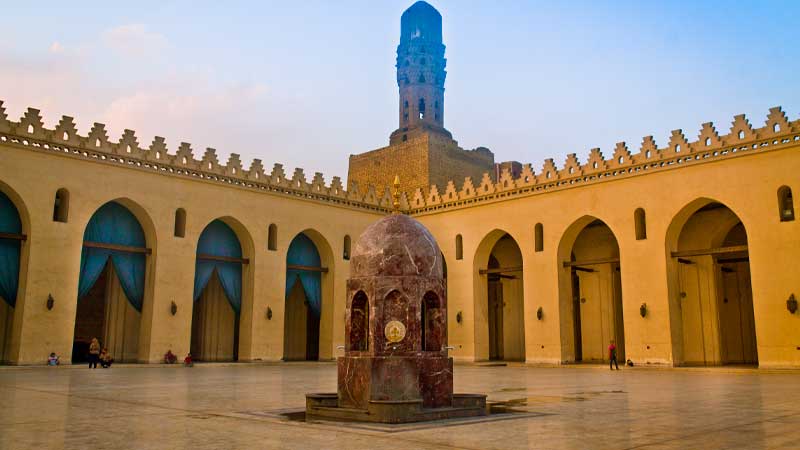
Construction of the Al-Hakim Mosque began in 990 during the rule of Caliph Al-Aziz, but Al-Hakim Bi Amrillah completed it in 1012 and duly named it after him. Al-Hakim Bi Amrillah inherited the throne from his father, Al-Aziz, in 996, just six years after building work started.
Unlike his father and his grandfather, who ruled before him, Al-Hakim Bi Amrillah was brutal and was routinely accused of torture. It was no secret that he had rivals assassinated. Ironically, he was assassinated in 1021, just nine years after the Al-Hakim Mosque was completed.
When the mosque was built, it stood just outside the old city of Cairo, just behind the northern wall. However, in 1087, it was incorporated into the city, at which point its north border, along with its two minarets, became a part of the city’s fortifications.
Sadly, a significant earthquake hit Cairo in 1303, which partially destroyed the upper sections of the minarets, and also caused severe damage to other parts of the Al-Hakim Mosque. The following year, in 1304, Baybars, a great Mamluk leader, had the mosque repaired, and as a result, some of the mosque’s original features were inevitably lost. However, much of the original architecture remains, even to this day.
Much of the mosque’s architectural style and design combines the techniques and features employed during the construction of two other Fatimid mosques in Cairo, the Ibn Tulun Mosque and the Al-Azhar Mosque. Perhaps it is worth noting that some of the architectural styles and features found at these three Fatimid mosques were later replicated by European architects.
Booking now our tour Day Tour around Old Cairo & Museum of Civilization
0 Comment