


Al-Azhar Mosque is one of Cairo’s oldest and most important mosques, and this Mosque is considered the first Islamic university in Cairo and the second in the world. The Islamic structure is located in the bazaar of Khan El-Khalili, the Citadel of Saladin, and especially in the mosques.
The History of the Al-Azhar Mosque
The Mosque was built during the Fatimid dynasty. In 969, Caliph Al-Muiz ordered Gawhar Al-Sequely to build the new city Of Cairo. One year later, in 970, Al-Muiz ordered the construction of the first Mosque in his new city of Cairo. The structure of the Mosque finished in 972, and it was first opened for prayer.
In 988, a school was founded in the Mosque, and it was considered the center of the Shia doctrine. The Mosque was not only for religious studies but also for science, medicine, and other studies. After the Fatimid dynasty ended, the Ayyubid dynasty was started by Saladin. Saladin wanted to end the Shia doctrine; that’s why the Mosque did not matter. Since the arrival of the Mamluks, they added schools, others built minarets and imported, extended, and restored the Mosque.
The Construction of the Al-Azhar Mosque
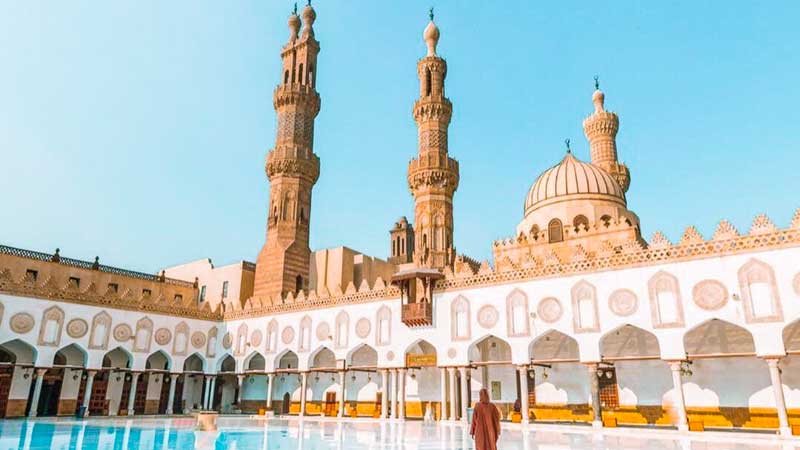
The Mosque was built in the center of Islamic Cairo. The changes in the Egyptian government are reflected in the construction of the Mosque as a monument of Ancient Egypt, Romans, and Greeks. The original Mosque was small, rectangular, 85 m and 65 m.
There was a prayer hall and a courtyard with a wall. The current Mosque is larger than the original. The present Mosque has almost six gates, but the main entrance is “Bab Zewela,” the barber’s gate (built in the 18th century). Ancient pillars surround a sizeable white marble patio.
There is also a study room and a library with 100 thousand volumes, some of which are ancient manuscripts from the 8th century. The five minarets are from dynasties (the 14th, 15th, and 16th centuries).
About Al-Azhar Mosque
It was said that the name of the Mosque was chosen after the name of the daughter of the Prophet Muhammad, “Fatima Al-Zahraa.” Al-Zahraa means the bright or shining one. Although the changes and renovations in the Mosque, there is some Fatimid ornamentation, such as natural plant motifs, geometric styles, and Kufic writing. In some detail, the Mosque resembles the Mosque of Amr Ibn Alas (the first Mosque in Egypt and Africa).
0 Comment