


The Al Rifai Mosque in Cairo
One of Cairo’s big and famous mosques is the Al Rifai Mosque. This Mosque is the best destination for those who want to enjoy Islamic architecture. It was built in the Plaza of the Citadel of Saladin, in front of the Mosque of Sultan Hassan (14th century), which was built around 1361.
It is also the mausoleum of the last Shah of Iran, “Muhammad Reda,” and several members of the royal family as king Farouk, king Fuad I and princess Farida.
The History of the Mosque of El Refai
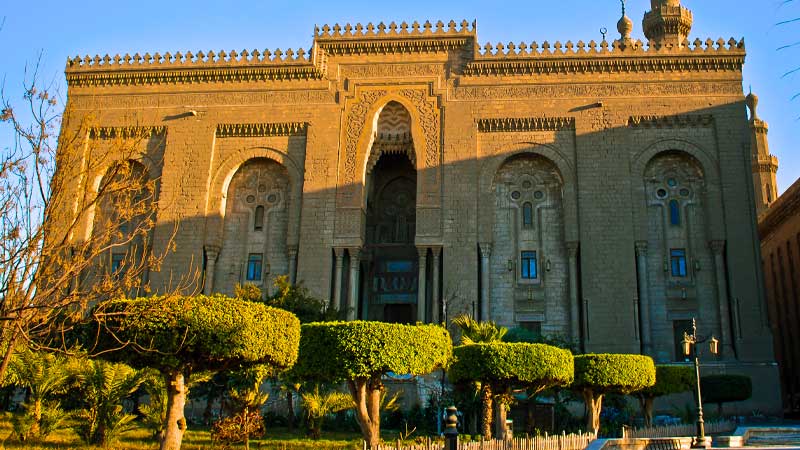
The Al Rifai Mosque was built in two stages between 1869 and 1912. “Zauía de Al Rifaí” originally had two mausoleums, one of “Ali Abu Shabak” and the other of “Yahya Al Ansari.” In 1869, “kosher” (wife of one of the sons of Muhammad Ali) ordered to renovate of “zauía de Al Rifaí” and build two domes on the two mausoleums, and also bought the places around them to destroy them and build a mosque as a cemetery of the royal family.
The engineer “Hussien Fahmy Pacha” put the plan and design of the Mosque, but he died during the construction of the first stage of the Mosque. In 1880 the building stopped to change some designs. After the death of “Khoshiar” in 1885, the construction was still suspended, but “Khoshiar Hanem” was buried in the Mosque.
In 1905, after 25 years of stopping the structure, governor “Abbas Helmi II” ordered the architect “Max Hatz Pacha” to complete the construction of the Mosque. The minarets were built in 1909, and in 1911 the construction was finished. In 1912 the Mosque was opened to the public; at this time, it was considered one of the best mosques built during the 20th century.
The construction of the Mosque of El Refai
The Al Rifai Mosque is rectangular, almost 6500 square meters around a dome. Nearly 1700 square meters are dedicated to prayer, and mausoleums occupy the rest.
The Mosque has different doors, but the main entrance is on the west side under a dome decorated with gold.
After the main hall is the tombs of Abu Shabak and Ali Al-Ansari. The doors and windows are decorated with gold and wood. The walls are marble with colors from 7 different countries. The ceiling is high and hollow. There are almost 44 pillars decorated with golden Koran verses. The two minarets are erected on round bases and decorated in different styles from the Mamluk period.
Check out our Egypt Vacation Packages & Trips
0 Comment