
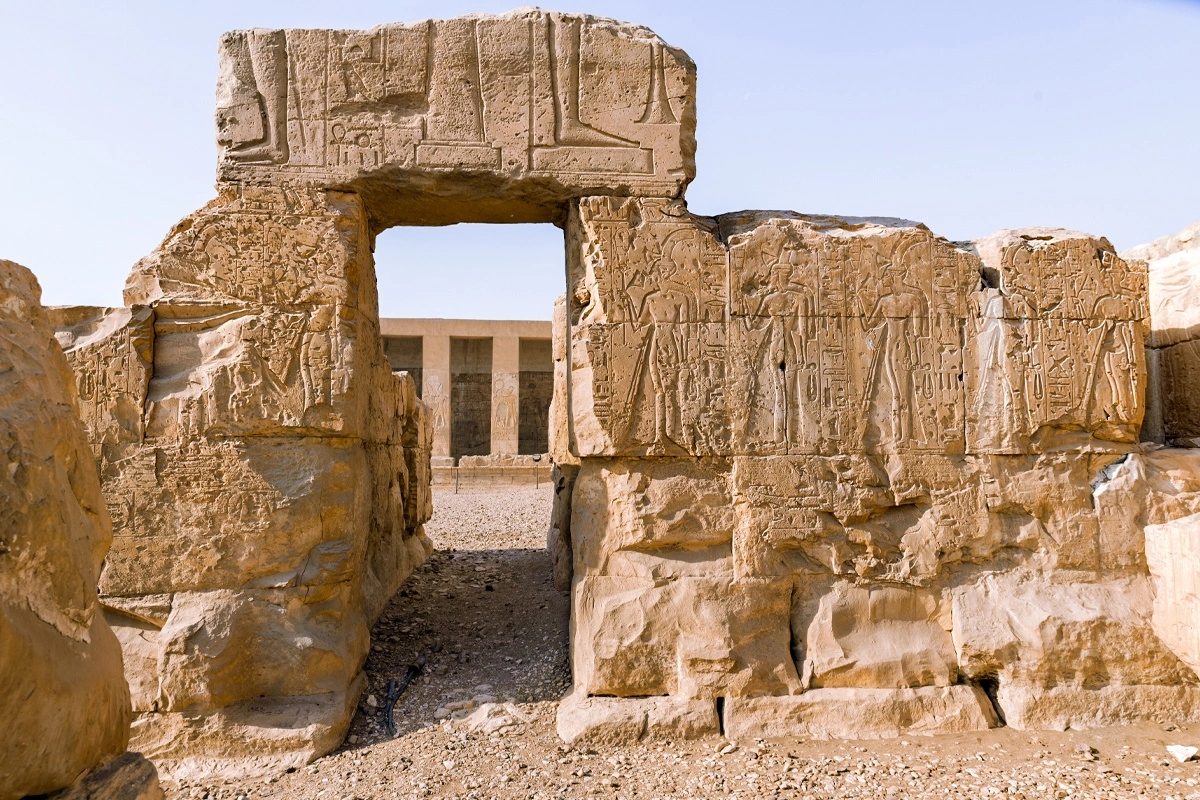

The Temple of Abydos
Upper Egypt is home to many ancient temples. One of the prominent temples is the Temple of Abydos. This Temple is on the western bank at Sohag, 135 km north of Luxor and 420 km south of Cairo. In ancient times it was the capital of the VIII Nome of Upper Egypt. The Temple of Abydos is also known as the Mortuary Temple of Seti I.
The History of the Temple of Abydos
In the Naqada I period, Abydos was considered a pilgrimage center because it was believed that the head of the god Osiris was buried on this site. From the Middle Kingdom, constructions dedicated to the god Osiris were found. Seti I was a king of the 19th dynasty in the New Kingdom, opening Minas, rebuilding the damaged temples, and completing the construction of the hypostyle hall at Karnak Temple.
Seti I wanted to build his Temple next to “the Staircase of the Great God.” The Abydos Temple was built in 1279 by King Seti I (father of Ramses II). The construction of his Temple at Abydos was completed by his son Ramses II, and Ramses II added two patios and a 62 m tower. The Temple of Abydos was built 3,400 years ago, but scientists believe it dates back to the ice age.
The Construction of Abydos
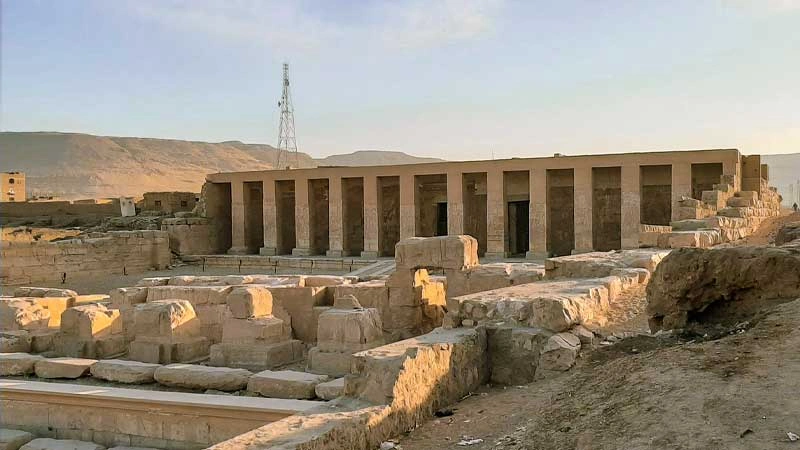
The Temple is in the shape of the letter “L” and was built with white limestone. The Funerary Temple of Seti I is surrounded by a wall 220 meters wide and 273 meters long, made of brick with different thicknesses. Its height is from 5 to 8 meters. To the northeast of the Temple is the main entrance of the Temple that leads to a tower where statues of Ramses II and Seti I were placed. Its walls are decorated with the battle of Kadesh; there are also two walled wells.
A ramp ladder leads to the second tower, which is smaller than the first. This pylon is a room with 12 pillars; its decorated walls are better preserved than the first and represent scenes of King Ramses II with various gods and in different battles. Another ramp staircase leads to a room with 12 pillars and a ceiling, which initially had seven entrances to each sanctuary, but Ramses II closed them. This room leads to the first hypostyle room with a canopy supported by 24 papyrus columns.
The walls have 14 doors that lead to the second hypostyle hall with a roof and 12 columns. Seven ramp stairs lead to the entrance to the seven sanctuaries; one of King Seti I and others dedicated to the six gods, Ptah, Amun-Ra, Horus, Isis, Osiris, and Ra-Horajty. All the shrines have a false door except the Osiris shrine, which has an actual door leading to the Osiris Temple. Originally in the sanctuaries, there were the sacred ships of the gods. To the right of the covers doors, there is a door leading to two chapels: one dedicated to Nefertem and the other to Ptah-Socar.
The Temple of Osiris
The Temple of Osiris was where the restoration of Osiris was celebrated. The entrance of the Osiris Complex leads to one with decorations of the restoration of the god; on its north side, there are three chapels dedicated to Horus, Isis, and Osiris, and the opposite is a hall with four columns. The decorations are in poor condition, and the walls are damaged.
Osireion / Osirion
The Osireion is behind the Complex of Seti I. The purpose of the Temple is not clear, but its features are unique. The Osirion was built by Seti I and completed by Merenptah, son of Ramses II. It is a depression at ground level, and ditches surround its central hall; there are 17 rock niches in front of each of which is a ledge. A burial mound originally covered it. This place was decorated with Afterlife scenes, such as the Book of Caves and the Book of Doors.
The Royal List of Abydos
What is very important in the Temple is the “Royal List of Abydos.” It is located on a wall in a corridor, next to the chapel of Ptah-Socar, and King Seti; I built it. It is a list of hieroglyphic cartouches with 76 names of the pharaonic king’s predecessors of King Seti I, from Menes (the 1st dynasty) to Seti I (19th dynasty). The cartridges are arranged in two horizontal rows. In this list, the names of the kings of the first and second intermediate periods are not mentioned, in addition to the terms of some kings of the 18th dynasty for religious or political reasons, among them; Hatshepsut, Akhenaten, Tutankhamun, Ay.
The Hieroglyphics of Abydos or Reliefs of Abydos
In the 20th century, reliefs such as modern vehicles were discovered in the Temple of Abydos. These hieroglyphs are images of a helicopter, plane, submarine, UFO, and battle tank. These images explain that these hieroglyphs originated during the reign of Seti I and were “He who rejects the nine enemies of Egypt.” Over time, these hieroglyphs were filled with plaster, and later Ramses II wrote again about the old ones, ” The one who protects Egypt and destroys foreign countries.” Over time the application was eroded, leaving these images of both inscriptions which give these images of vehicles.
0 Comment