


The Citadel of Qaitbay
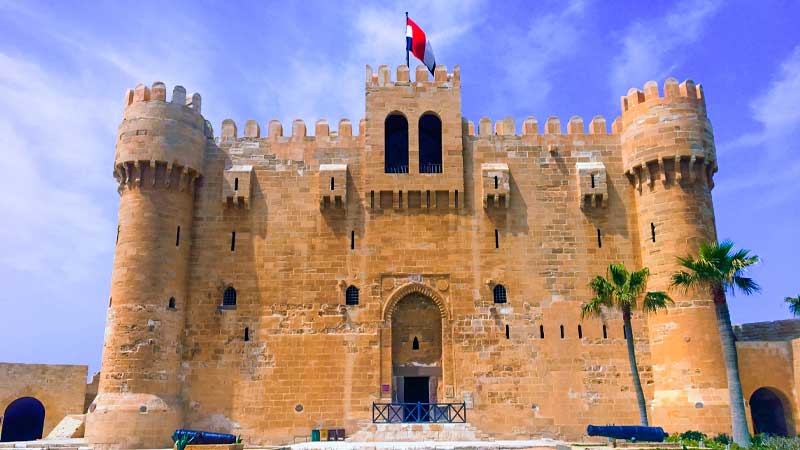
One of the most famous attractions in Alexandria is the Qaitbay Citadel. The Citadel of Qaitbay was an important fortress of Egypt and the coast of the Mediterranean Sea. The Citadel is east of Alexandria’s port, where the Island of Faros used to be. The Citadel was built on the same site as the famous lighthouse of Alexandria, considered one of the seven wonders of the ancient world before its destruction by another earthquake in the 14th century.
The History of the Citadel of Qaitbay
The Mamluk sultan “Al-Ashraf Saif Al-Din Qaitbay” imported art and architecture, which is why he renovated many buildings, more than 70 buildings, such as madrasas, mosques, agencies, public fountains and the citadels of Alexandria and Rosetta (the city of Rashid) to protect northern Egypt from the Ottomans.
Qaitbay built Qaitbay Citadel between 1477 and 1479 in the 15th century. Due to the military importance of the Citadel, it was occupied by most rulers throughout history. In the Mamluk empire, it was considered a defensive fortress of the Ottomans. After the conquest of the Ottomans, the Citadel was also used for protection and defense.
After the military weakening of the Ottomans and the French expedition in Egypt, the Citadel lost its military and defensive importance. In the 19th century, Muhammad Ali (the ruler and founder of modern Egypt) restored the Citadel, and then Muhammad Ali’s successors imported the Citadel until the Orabi revolt in 1882. In July 1882, Alexandria suffered much Damage from British fleet bombardment, especially the Citadel area.
The Citadel was abandoned until 1904, when King Faruq I renovated the Citadel to be the residence of the royal rest. In 1952 it was converted into a maritime museum by naval troops. In 1984 the Supreme Council of Antiquities planned to do the Citadel’s most extensive restoration.
Alexandria suffered much damage from the British fleet bombardment, especially the Citadel. The Citadel was abandoned until 1904, when King Faruq I renovated the Citadel to be the residence of the royal rest. In 1952 it was converted into a maritime museum by naval troops. In 1984 the Supreme Council of Antiquities planned to do the Citadel’s most extensive restoration.
Alexandria suffered much damage from the British fleet bombardment, especially the Citadel. The Citadel was abandoned until 1904, when King Faruq I renovated the Citadel to be the residence of the royal rest. In 1952 it was converted into a maritime museum by naval troops. In 1984 the Supreme Council of Antiquities planned to do the Citadel’s most extensive restoration.
The Construction of the Citadel of Qaitbay
The architect of the fortress is Qagmas Al-Eshagy. It was said that one hundred thousand dinars were spent on its construction. The construction of the Citadel lasted two years, occupying 17,550 m2. The Citadel was designed with the same architecture as the medieval Islamic fortress. The massive wall that surrounds it, an inner wall, and the central tower were built by the ruins of the Lighthouse of Alexandria.
From Outside: The Citadel is surrounded by the sea on three sides and has two massive walls, inner and outer, on side four. The outer wall surrounds the Citadel from all four sides, its height 8 m and width 2 m, in which you can notice defensive openings that the soldiers used. In the inner wall are the army barracks and warehouses and
From Inside: The entrance is an Aswan red granite passageway with a garden. The main building is square with four semicircular towers and contains three floors. On the first floor is a large mosque with a minaret, four iwans (places of prayers), and a courtyard. The second contains its yellow corridors, giving you the impression of being in a labyrinth—the third consists of a large circular room with the ruler’s lathe.
0 Comment