


About Kharga Oasis
Kharga Oasis is a magical attraction like A White desert oasis, Bahariya Oasis, and other Egypt oases. It is filled with heavenly attractions worthy of exploring. In the vast sand ocean of the western desert lies the beautiful green Kharga Oasis, out of the lifeless nature of the desert like a jewel in a pile of coal.
It is one of the best places in Egypt and the world that can reflect the natural beauty and culture of the Egyptian Oasis most majestically.
Location of Kharga Oasis
The Kharga Oasis is 550 km south of Cairo and 232 km south of Asyut; it is on the west bank of the Nile valley, about 200 km west of the western desert. Occupying the eastern border of the governorate are the cities of Al Menya, Qena, Asyut, and the Matruh governorate occupies its northern borders. The Oasis was known as the southern Oasis by the ancient Egyptians and the Oasis Magna to the Romans, who are the largest oases in the Libyan desert of Egypt.
The Oasis is in a depression about 160 km (100 mi) long and from 20 km (12 mi) to 80 km (50 mi) wide. The climate is 28°C, Wind N at 8 km/h, and Humidity at 23%. Kharga Oasis occupies around one-third of the entire land of Egypt and has about 20,000 inhabitants nowadays. Kharga Oasis is connected to the Nile valley with a set of roads from Asyut to Kharga and Farafra to Dakhla to Kharga.
If you want to spend the holidays in Egypt, check out our Egypt Vacation Packages & Trips.
History of Kharga Oasis
The history of Kharaga Oasis was an important transit point for the desert caravans in the 12th dynasty (1786 BC-1665 BC) when the Hyksos controlled northern Egypt, and the Pharaohs ruled southern Egypt and Nubia. It served as the southwestern gate of Egypt because it connected Egypt to South Africa.
The Kharga Oasis flourished during the 13th dynasty and was used as a stronghold to protect Egyptian Christians from the unjust rule of Roman rule.
Several huge buildings, passageways, artifacts, and ruins were discovered in the Oasis, dating back to the middle kingdom (2134 -1569 BC) and the new kingdom (1550-1050 BC). The famous dagger of King Tutankhamun was made from an Iron Meteorite located in the Kharga Oasis. The Greek historian Herodotus mentioned the Oasis where the Persian king Campuses and his army rested on their way to destroy the Oracle temple of Amon-Zeus at Siwah before they vanished.
Temples in Kharga Oasis
1- The Temple of Hibis: One of the most important ancient sites in Kharga Oasis is the temple of Hibis; it is highly significant as it holds Pharaonic, Persian, Ptolemaic, and Roman eras influences. It was constructed in the 26th dynasty before the Persian conquest in 525 BC by Psamtik II.
The temple was built to worship the holy triad (Amun- Mut –Khonsu) under the rule of Ahmos II and was completed during the Persian and Hyksos. The temple was slightly redesigned in the Greco-Roam period between (380 -246 BC) at the hands of Ptolemy II (258 -246 BC). The temple has a sacred lake and ports in the east, and a Roman gate that dates back to 69 A.D. Inside the temple is a majestic sanctum with remarkable and unique inscriptions.
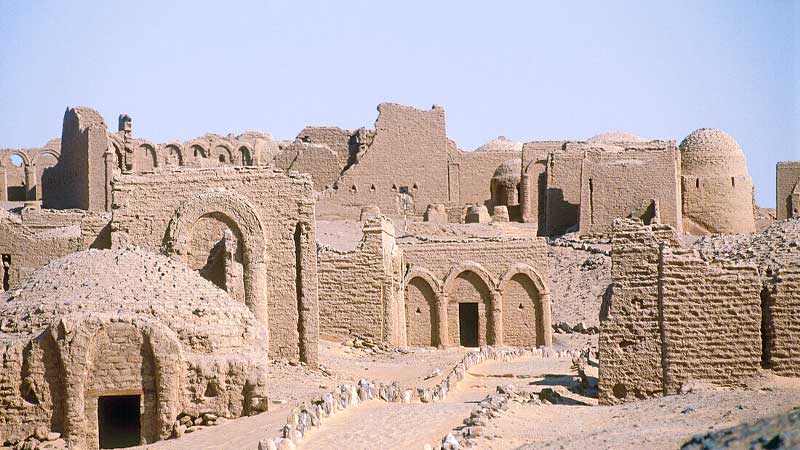
2- The Cemetery of Bagawat: The Cemetery of Bagawat is located three kilometers north of Kharga, behind the Temple of Hibis. The cemetery’s name comes from its unique style of architecture, as most of the tombs in this area were constructed in the form of domes or “Qubwat” in Arabic, which transformed afterward into Bagawat.
This cemetery holds one of the most critical, enchanting, ancient Christian churches on earth. Bagawat dates back to the seventh century A.D. when Christians escaped northern Egypt and then fled to the Kharga Oasis.
The cemetery contains 236 tombs constructed as small domed chapels with a central church in the middle known to be one of the most ancient Coptic Churches in Egypt. The most important tomb in the cemetery is the legendary tomb of Exodus. The magnificent tomb of “peace” contains the reliefs of Jacob, the Virgin Mary, Saint Paul, and Saint Takla.
The graves can display many magical, colorful Coptic writings and inscriptions that shed some light on Coptic life during this period.
3- The Temple of Ghweita: The Temple of Ghweita or Qaser Ghweita means fortress of deep springs, located 25 kilometers south of Kharga. The Temple of Ghweita, together with the Temple of Hibis, is known to be the only temple built in Egypt during the Persian or Hyksos occupation.
The construction work of the Temple of Ghweita started in the reign of Darius I on the top of a hill that was initially the ruins of a Pharaonic settlement. The temple was built specifically for worshiping the holy triad of Amun, the father; Mut, the mother; and Khonsu, the son, just like the temple of Hibis.
It was also enlarged during the Ptolemaic era between the 3rd and 1st century B.C. That holds a hall with eight massive columns, a hypostyle gallery, and a sanctuary. The Temple of Qaser Al Zayyan, The Temple Of Qaser Al Zayyan, is found 5 kilometers south of the Temple of Ghweita.
This temple was built during the Ptolemaic reign and enlarged during the period of the Roman emperor Pius in the 2nd century A.D. The temple of Qaser Al Zayyan was dedicated to the cult of Amun Ra of Hibis. It contains a sanctuary made of white limestone blocks and many mud-brick side chambers.
0 Comment