


The Bahariya Oasis
Bahariya Oasis One of the famous Oasis in Egypt is the Bahariya Oasis. It is located in the Western Desert of Egypt, closer to Farafra Oasis. It is the closest Oasis to Cairo, almost 420 km from Cairo. It has the shape of an oval, stretching from north to southwest with a length of up to 94 km and a width of up to 42 km.
Its full extension is 2000 km2. The Bahariya Oasis is known as the Oasis of the north. Most villages are Bedouin and Muslim, and many mosques are in the Oasis.
The History of the Bahariya Oasis
It has been inhabited since the predynastic. It was mentioned among the inscriptions of the Temple of Edfu because, in the Pharaonic era, it was the center of agriculture. In the middle empire, it was noted for its wine. In the XXVI dynasty, it was an important center of agriculture and commerce.
In the Greco-Roman era, they began to fight to take control of the Bahariya Oasis due to its importance. Still, from this moment, the decline of agriculture and the economy started. Arab armies, merchants, and pilgrims passed through the Oasis in Islamic times. The worldwide tourist fame of the Bahariya Oasis began in the 90s of the last century when some monuments from the Greco-Roman period were discovered.
If you want to spend the holidays in Egypt, check out our Egypt Vacation Packages & Trips.
The Description of the Bahariya Oasis
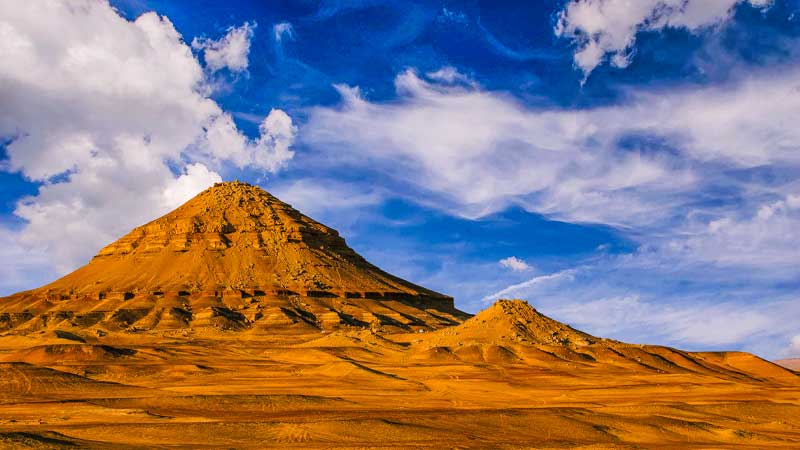
It is covered with limestone and basalt from the Eocene period, surrounded by mountains and black rocks formed by black volcanic rocks.
There are date palms and trees of different productions, such as guavas, mangoes, and olives. It has 5 Mariya villages, El Qasr, Zabu, Al Heiz, and Bawiti (the capital of the Oasis and the largest village). Bahariya’s name is from the Arabic word “Bahr,” which means sea because the Mediterranean Sea is to the north of the Oasis.
The Attractions of the Bahariya Oasis
1- The Valley of the Mummies: In 1992, this valley was discovered, dating back to the Greco-Roman era. This valley contains 34 tombs and 10 thousand mummies known as “the Golden Mummies” because their faces are covered with gold. These mummies are exhibited in the Bawiti Museum.
2- The Tombs of Zed-Amon-Ef-Anj and his son Bannentiu: are burial chambers from the 25th dynasty. Zed-Amon-Ef-Anj was not a ruler, but it seems he was a wealthy merchant. The tombs are decorated with preserved colors and papyrus columns with scenes from The Book of Deaths, like the royal tombs.
3- The ruins of the Roman Fortress: It is near the Valley of the Mummies and is considered the largest fortress of Roman times in the western oases. There are also the remains of the Basilica Church, which was built in the 5th century.
4- Hot springs: are considered a treatment destination. One of them is Bir El Ramla, considered the closest and warmest spring in Bawiti. There is also Bir el Negba and Bir el Mattar.
5- The Temple of Alexander the Great is the only building built in honor of Alexander the Great after he visited the Oasis in 332 BC. C. The Temple is decorated with scenes of Alexander the Great with the gods.
0 Comment