


The Kalabsha Temple
Kalabsha Temple An ancient temple was originally in a region called “Bab Kalabsha,” the gate of Kalabsha, 50 km south of Aswan, but is now near the High Dam. He is known as “Mandulis,” which refers to the sun god for the Nubians. It remains one of the best examples of Nubian architecture and construction in Ancient Egypt. Travelers give it the name “The Karnak of Nubia.” This Temple is considered an island in Lake Nasser.
The History of the Kalabsha Temple
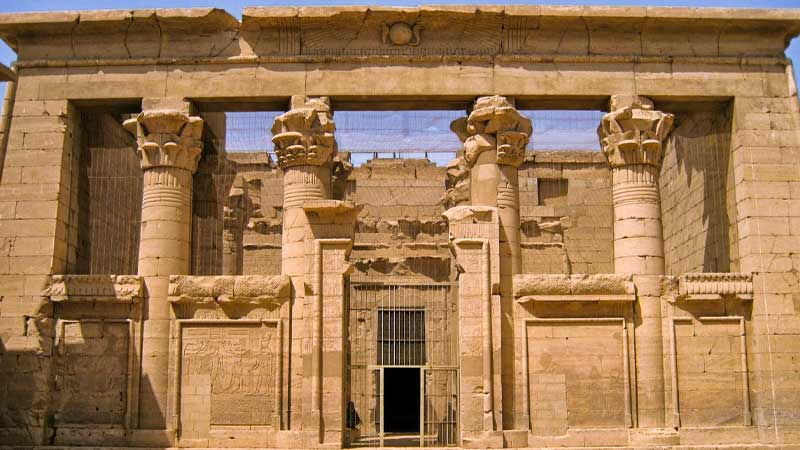
It was built in 30 a. C. during the Roman Empire’s reign of Emperor Augustus. It was dedicated to the goddess “Mandulis” (the Greek name for the Nubian god “Merkel,” a local form of the god Horus), as well as Osiris and Isis.
The Kalabsha Temple was built on the ruins of another unfinished temple built by Amenhotep II of the 18th dynasty. During Christianity, the Temple was used as a church. With the help of the German government, the Kalabsha Temple was moved to protect it from flooding after the construction of the High Dam.
The Temple was cut down to 13,000 pieces and moved to the new site, which is just 1 km south of the Dam, and the relocation took two years. During the relocation work, elements of older buildings were found, such as a statue of King Tuthmosis III and a stele of Amenhotep II, so it is assumed that an earlier building already existed in the New Kingdom.
In addition, remains of a smaller temple from the Ptolemaic era were found. In the new place, around this Temple, three other temples were moved; the Temple of Amun (Beit El Wali), the Temple of Qantas, and the Temple of Gerf Hussein.
The Description of the Kalabsha Temple
The Temple is 76 meters long and 22 meters wide. The Temple consists of a tower, a court, a hypostyle hall, two vestibules, and a sanctuary, according to the following plan; a monumental entrance tower, followed by an open court, a hypostyle (pillared) hall, and vestibules preceding the sanctuary which is similar in size to the thresholds.
The open court in Kalabshi temple had an arcade with 14 columns on the north, east and south sides, but only the columns on the north and south sides still retained their original height. A staircase leads to the roof from the sanctuary halls, where a view of the Temple itself and the sacred lake can be seen.
On the walls of the Kalabsha temple were various historical records, such as “a long inscription carved by the Roman Aurelius Besarion in 250 AD, decorated with gold and wood. The walls are marble with colors from 7 different countries. The ceiling is high and hollow. There are almost 44 pillars decorated with golden Koran verses. The two minarets are erected on round bases and decorated in different styles from the Mamluk period.
0 Comment