


The Aswan High Dam
The annual inundation of the Nile since ancient times turned the lands near the Nile into fertile land, but due to the rising level of the floods, the temples sank utterly. That is why it was necessary to build a dam to save the temples on the Nile banks.
The Aswan High Dam is essential as a tourist destination and crucial in the whole country’s life. It is 13 km south of the city of Aswan. It was built with Soviet help, so a symbol of friendship with the Soviet Union in the form of a lotus flower was constructed near the High Dam.
The Story of the Aswan High Dam
In 1889 construction began on the first Aswan High Dam, the Aswan Low Dam, and the Lower Dam was completed in 1902. The Lower Dam was 54 m high, and later its height was increased in two phases; from 1907 to 1912 (size was increased by 5 m) and from 1929 to 1933 (height was increased by 9 m). In 1946 the Lower Dam was about to overflow, so they decided to build another dam 8 km upriver. In 1952 the construction of the new dam, “Aswan High Dam,” began during the time of President Gamal Abd El-Nasser.
Nasser first requested financial assistance from the International Bank for Reconstruction and Development and technical assistance from the United States and Great Britain. In the beginning, the United States offered a loan of 270 million dollars, but it was withdrawn until mid-1956. In 1958 the Soviet Union (at the height of the cold war) offered a loan of 1,120 million dollars at 2% interest. Construction lasted eleven years and was completed in 1970.
Construction of the Aswan High Dam
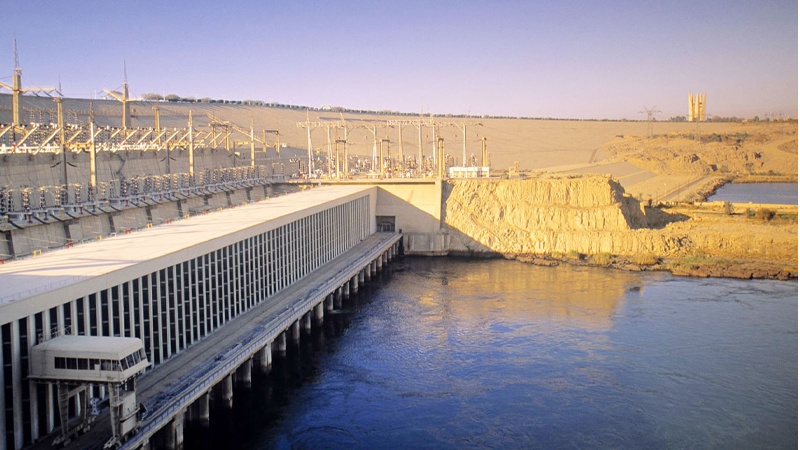
The Aswan Low Dam is 5 km south of Aswan, and its volume is 43 million m 3. It is 1950 m long and 36 m high, rises 40 meters above the level of the Nile, and has seven power generators. But the Aswan High Dam was built seven km above the first dam by layering Aswan red granite.
It took 36,000 workers and engineers to make it and required five times the amount of materials used to build the Pyramid of Cheops. It is 3600 m long and 111 m high, the base is 980 m wide, and the top is 40 m wide. Its capacity is 157 km 3 of water.
Since the construction of the High Dam, Lake Nasser has been considered the largest artificial lake in the world. The lake was named after Egyptian President Gamal Abdel Nasser. Lake Nasser is 500 km long, 16 km wide, and occupies 6 thousand m 2.
The Consequences of the Construction of the Aswan High Dam
Advantages of the Aswan High Dam:
- Provided a stable source of water for the Egyptians.
- Helps control flooding in the Nile River.
- Allows multiple crops simultaneously instead of just one harvest.
- Its 12 power generators generate more than half of the electricity needed throughout Egypt.
- Farm income increased by 200%.
- Lake Nasser, one of the largest artificial lakes in the world, was created, expanding fishing activities.
- Development of fertilizer and metal industries that would provide employment and income to the surrounding inhabitants.
- Travel between Sudan and Egypt has become more accessible.
- Opportunities for tourism along the Nile River and throughout Egypt have increased.
Disadvantages of the Aswan High Dam:
- Many archaeological sites were relocated so as not to lose them due to the rising water during their construction, such as the Temple of Abu Simbel, the Temple of Philae, the Temple of Kalabsha, and other reconstructed sites outside of Egypt in the museums of Berlin, Leiden, Madrid, New York, and Turin.
- Nearly 11% of the dam’s water is lost through evaporation.
- Due to its effects on the ecosystem balance, water-borne diseases that affect animals and humans have emerged.
- A large number of Nubians (nearly 90 thousand) lost their homes to the flooding of Lake Nasser after the High Dam was built.
- Decreased land fertility because the silt does not reach the soil without flooding caused the use of artificial fertilizers necessary to add nutrients to the ground.
- As the water in the lower regions flows more slowly, there is more growth of phytoplankton (small floating plants that grow in the water), and the drinking water used must be cleaned with higher amounts of chlorine.
- Since there is less water at the lowest points after the dam, salt from the Mediterranean Sea slowly enters the interior, making the soil and groundwater saltier than usual. This is destructive to soil and drinking water and is, therefore, unsuitable for water supply and irrigation.
- Migration of marine animals to the river due to increased salinity.
0 Comment