


The Oasis of Farafra
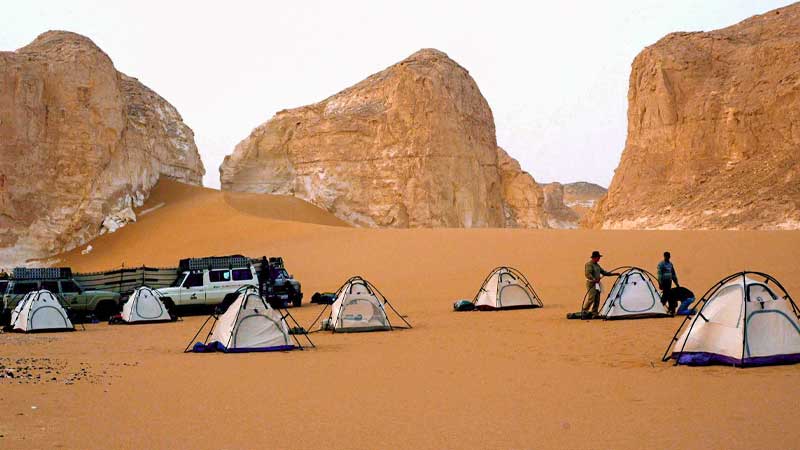
The Oases are the great treasure of the Western Desert in Egypt. Farafra Oasis has a natural beauty of its own.
It is in western Egypt between the oases of Dakhla and Bahariya. It is 180 km from the Black Desert, 170 km from the Bahariya Oasis, and 627 km from Cairo.
It is the smallest, least populated, and most isolated Oasis among the Oases of Egypt.
It has more than 5 thousand Bedouin inhabitants and farmers who live in Qasr El Farafra, the only village in the Oasis. The inhabitants of the Oasis respect their original customs and cultures.
Its houses are built in the traditional way of adobe and painted; the streets are narrow. It contains more than 100 hot water wells, most of which are used for irrigation.
If you want to spend the holidays in Egypt, check out our Egypt Vacation Packages & Trips and New Year and Christmas deals in Egypt.
The History of the Farafra Oasis
It was known to the ancient Egyptians as “Ta-Iht,” which means the land of the cow after their goddess Hathor.
The Oasis was known among the pharaohs and was mentioned in the temple inscriptions as; in the Temple of Karnak, the occupation of Farafra by the Libyan troops in the period of Pharaoh Merenhotep (son of Ramses II ) was mentioned; in the Temple of Luxor, it was cited as the origin of the minerals and in the Temple of Edfuthe seven oases and Ti-iht northwest of Kenemet (the Dakhla Oasis) were mentioned.
Some ruins of the Roman Empire include temples, tombs, and palaces in the Ein el Wadi and Wadi Abu. El Farafra was also the refuge of the Copts from Roman persecution. In the Islamic period, the Oasis flourished due to the trade of dates, tea, and olives between the Oasis and the Nile.
The Attractions of Farafra Oasis
- Hot Springs: such as Bir Sitta (the most famous spring in the Oasis for its ideal hot water), Ain Bishay (since Roman times and used in irrigation), and Abu Nus (a large tourist lake for relaxation and swimming).
- The Badr Museum: It is where there are sculptures of the artist “Badr.” His sculptures are made of stone, mud, and sand, and he also makes objects that reflect traditional life in Farafra.
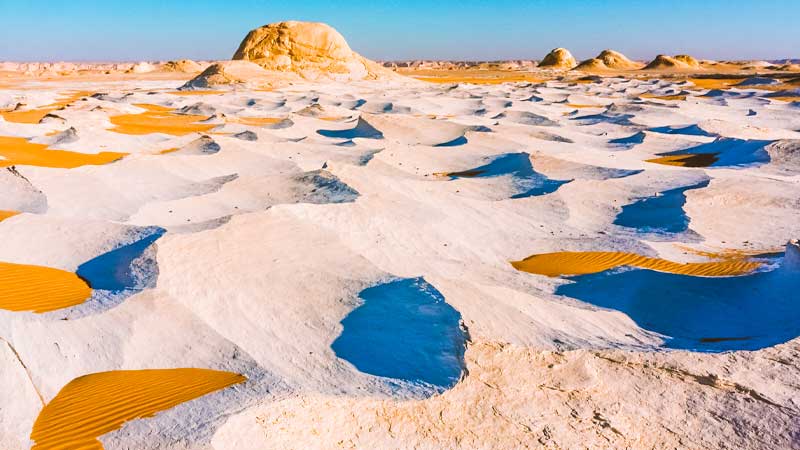
- The White Desert: It is north of Farafra and below sea level, so fossils of marine animals are found among rocks. It is covered in white limestone from sand storms. One of the best-known rocks is “The Finger of God” or “Al Qubar,” a 20 m high rock resembling a finger in the sandy heart of the western desert.
- The Black Desert: is covered with black rocks due to volcanic activity for thousands of years.
- The Crystal Mountain: is between the White and Black deserts, formed from calcite crystal rocks.
Activities you can do in Farafra Oasis.
- See local handicrafts and buy socks and scarves knitted from the wool of camels and sheep.
- Visit the Badr museum.
- You will have the opportunity to reach Bir Sitta hot springs and Lake El Mufid.
How is the weather in the Oasis of Farafra?
The weather is good from October to April, and the summer temperatures reach almost 35° and 45° C.
[ Read more about the climate in Egypt ]
0 Comment