


Medinet Habu – An Ancient Mortuary Temple Of Ramesses III
Medinet Habu is the name given to the ancient Mortuary Temple of Ramesses III, located on the West Bank in Luxor. The area where it stands is also called Medinet Habu, so many people refer to the temple as “Medinat” Habu. The temple dates back to the New Kingdom period, and it’s most famous for its vast amount of well-preserved reliefs and massive statues of Ramesses III.
A Brief History Of Medinet Habu
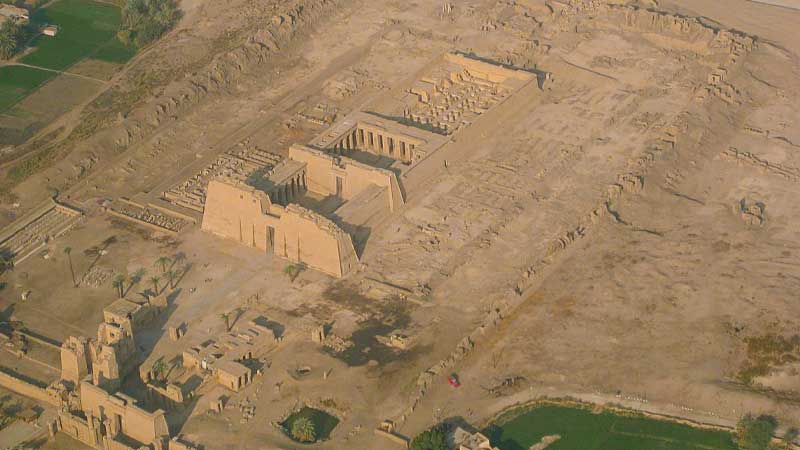
Medinet Habu is the second-largest ancient temple ever discovered in Egypt, covering more than 66,000 square meters. The temple, one of the top Luxor tourist attractions, was explicitly built as a mortuary temple by Ramesses III, the second pharaoh of the 20th dynasty and the last great pharaoh of the New Kingdom. While the temple was built for Ramesses III to practice mortuary rituals, it was also used to worship the god Amun.
Pylon of Medinet Habu Temple
Given its vast size and grandeur, some historians and Experts have speculated that Ramesses III had attempted to rival the temple built by the great Ramesses II, which coincidentally is located on the West Bank.
Visiting the Mortuary Temple Of Ramesses III
Many visitors to Medinet Habu visit while enjoying Nile River cruises, although the site is also featured in some other tour packages. Those who stay will typically enter the site via a giant gateway with two massive columns on either side. After passing through the gateway, one can see the ruins of Ramesses III’s royal palace, and one needs to take some time to fully appreciate the wealth of royalty during the New Kingdom era.
After passing through the first pylon, visitors will find themselves in a vast courtyard lined with massive statues of Ramesses III on one side and plain columns on the other. Visitors en proceed through the second and third pylons leading them to the old hypostyle hall. The hall would have at one time had a roof, but it is no longer there today.
The hypostyle hall is once again home to many well-preserved reliefs, but one of the most exciting things about the hall is that archeologists discovered many human heads on display. It is believed that they once belonged to captives and were put on display as a symbol of Ramesses III’s control of Nubia and Syria. However, visitors won’t see any heads today since they were all removed from the site.
Beside the Mortuary Temple of Ramesses III at Medinet Habu, there is also a small temple dedicated to the god Amun. This temple was initially built by Queen Hatshepsut and later altered by King Tuthmosis III before being modified again during the Roman period.
0 Comment