


The Valley of the Queens
One of the famous royal tomb locations is the Valley of the Queens in Egypt. This Valley is 1.5 km southwest of the Valley of the Kings on the west bank of the Nile in Ancient Thebes.
It was built to bury the royal wives of Kings, princesses, and their children during the New Kingdom. Four tombs of the 70 tombs in the Valley are open to the public: Nefertari and Titi, the two sons of Ramses III.
[ Check out our Egypt Vacation Packages & Trips ]
The construction of the Valley of the Queens
In the Valley of the Queens, there are more than 70 tombs of the queens of Ancient Egypt, many of which are richly decorated. The tombs were carved out of rock. The entrance to the Valley is a rocky corridor at the foot of the mountain that is less vast than the entrance to the Valley of the Kings.
The general design of the tombs is that there is a small antechamber after the opening. A high hall followed her. On the sides of the corridor, there are other chambers. The end of the gallery leads to the burial chamber decorated with the Book of the Dead with the gods Anubis and Osiris.
The most famous and beautiful tomb is the tomb of Nefertari. Also, the tomb of Titi, wife of Ramses X of the 20th dynasty, has beautiful paintings and scenes of Titi and the guardians of the Beyond, but some parts are damaged. Other graves; Isis, Betanta, Henuttauy, Jaemwaset, Prince Menjeperre (son of Thutmose III, Prince Ramses, Meritamon, and many others.
The History of the Valley of the Queens
The Valley of the Queens was protected by the goddess Hathor. It was where the queens of Ancient Egypt of the XVIII, XIX, and XX dynasties were buried from 1550 BC to 1070 BC.
The history of the place began when Ahmose I decided to bury his daughter near the Valley of the Kings, and later only the queens, daughters, and royal women were buried there until the reign of Ramses I, when princes, princesses, and some nobles began to be buried in this place. Most of the tombs were excavated in the 18th and 19th dynasties.
The Valley was known as ”Ta Set Neferu”, which means the place of beauty; by the Arabs, it was known as “Biban el Harim” or “Biban El Sultanat,” which means the gates of the queens. The Christians in year four destroyed many of their tombs and built a monastery whose ruins are found there. The first tomb was discovered in 1816, which is the tomb of Tyti.
In 1828, 24 graves were found. In 1903 the most famous and beautiful tomb in Luxor, the tomb of queen Nefertari, was by the Italian Ernesto Schiaparelli, who completed the discovery of the Valley in 1906.
Viewed from above, the Valley of the Queens looks rather unimpressive – a scattered, sunny rocky valley with simple stone entrances leading to the burial site where tombs were found with the remains of the wives of the buried pharaohs of ancient Egypt.
The Tombs in the Valley of the Queens
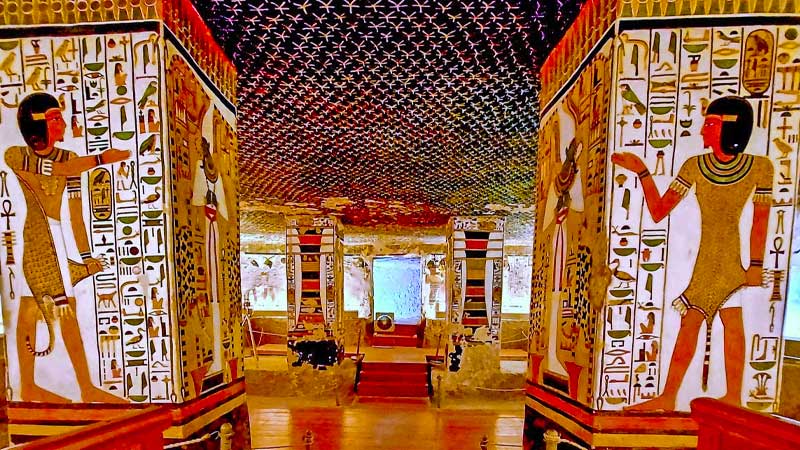
The Tomb of Queen Nefertari
Queen Nefertari was a queen of the 20th dynasty, whose name means the most beautiful. The tomb of Queen Nefertari was built by order of her husband, Dela Ramses II, in 1290 BC.
The paintings in Nefertari’s tomb are well preserved and depict her journey to the Afterlife. The grave is 27 m deep, and its opening is in the form of a papyrus. After the entrance to the right is the antechamber, where there are scenes of offerings and drawings representing Osiris, Anubis, and the goddess Hathor.
The walls of the stairway leading to the burial chamber are decorated with divine images. In the burial chamber, four pillars show Nefertari with gods. On one of the pillars, the goddess Isis is shown offering Queen Nefertari an Ankh (symbol of eternal life).
The Tomb of Prince Khaemwaset
It is a few hundred meters south of Queen Nefertari’s tomb. There, a small door embedded in the rock opens into a long corridor that runs through several chambers. Its walls are decorated with hieroglyphs painted red, green, blue, or black on a white and yellow background.
The Tomb of Queen Titi
Its entrance is a small door carved into the mountain’s rock that leads to chambers decorated like Prince Khaemwaset’s tomb, but Titi’s tomb is notable for its ceiling decorated with white stars.
The Tomb of Prince Amenherjepeshef
Like most Valley tombs, it is decorated with several corridors, at the end of which is the coffin. It is decorated with scenes of the pharaoh with the gods and his father, Ramses III.
0 Comment