


The Dendera Temple
The Dendera Temple Complex is considered one of the most preserved complexes in Egypt and the world. It is south of Abydos, on the eastern bank facing the city of Qena. In ancient times the city of Dendera was the capital of the VI nome of Upper Egypt and the center of the goddess Hathor (the goddess of love, beauty, and the sky).
The city was known as “Lunet,” and it was believed that this name was given by the goddess Hathor. In Greek times it was known as “Tentyra,” and at the end of the Ottoman times, the city was known by its current name, Dendera.
The History of Dendera Temple
The first construction of the Complex was started in prehistoric times. During the 4th dynasty, the temple was rebuilt by King Cheops (builder of the Great Pyramid of Giza ). The building was enlarged during the reign of Pepi I (6th dynasty). A gate built in the time of Mentuhotep II (11th dynasty) was discovered in 1995 BC but moved to the Egyptian Museum in Cairo.
Later the Complex was rebuilt again during the time of Thutmose III (18th dynasty) and was decorated with many kings of this dynasty, such as Ramses II, Ramses III, and Amenhotep III. The oldest surviving monument currently in existence in the Complex is the birth house monument (Mammisi) which was built in 345 BC by Nectanebo II (dynasty XXX).
The final construction dates back to the last Ptolemaic and Roman emperors. The Complex was under the sands until the middle of the 19th century. The first excavation of the Hathor temple was by the German Egyptologist Johannes Dümichen in 1876; Auguste Mariette excavated the entire Complex.
The Construction of the Dendera Complex
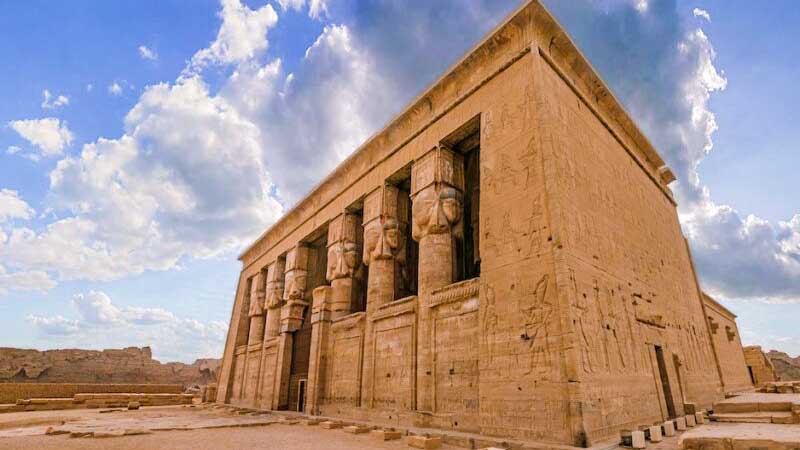
The Dendera Temple Complex is 40,000 m 2. A 10 m high brick wall surrounds the Complex. The Complex is better preserved because it was buried in the sand. The main temple in the Complex is the Temple of Hathor.
To the west is another birth house built by Emperor Augustus and decorated with scenes from Roman emperors from Augustus to Nero. To the north is another temple larger than Isis that Emperor Trajan built. To the east are a sacred lake covered with palm trees, Christian buildings (from the 5th century), and an adobe sanatorium (used to bathe in the holy water to obtain healing from the goddess). There are also two monumental gates of Domitian and Trajan, a Roman kiosk.
The Temple of Hathor at Dendera
The building is noted for its decorations, architecture, and columns. It is 79 m long. The entrance of the Temple of Hathor leads to the great hypostyle hall with 24 columns 15 m high. The columns are crowned with the goddess Hathor (the face of a woman with cow ears). The walls of the hypostyle hall are decorated with astronomical scenes. The ceiling is decorated with shrines of Osiris, such as the sun disk and the famous Dendera zodiac.
The decorations are hieroglyphics in blue. Inside, after the hypostyle hall, is the second smaller hall with six columns and richly decorated capitals. This room leads to the main sanctuary of the sacred ship of the goddess. There are small rooms, a treasure room, offering rooms, and storerooms on both sides.
Check out our Egypt Vacation Packages & Trips
0 Comment