


Alexandria’s Roman Amphitheatre is located in the Kom el-Deka neighborhood and near the railway station. It is one of the most recent discoveries in Alexandria. The Polish mission, in 1960, discovered the theater on the site of the old fortress built on the plateau. It is from Roman times and dates from the 2nd century.
We know that the theater occupied an important place in Roman culture, where they were interested in all kinds of art. It contains 13 white marble steps in a semicircular shape, and two pieces of mosaic decorated the entrance. Behind the amphitheater, there are several rooms probably used by actors and actresses to change their clothes during shows. The two sides of the amphitheater were made of steps, and its roof was covered by a dome that completely disappeared.
Roman theater Alexandria design
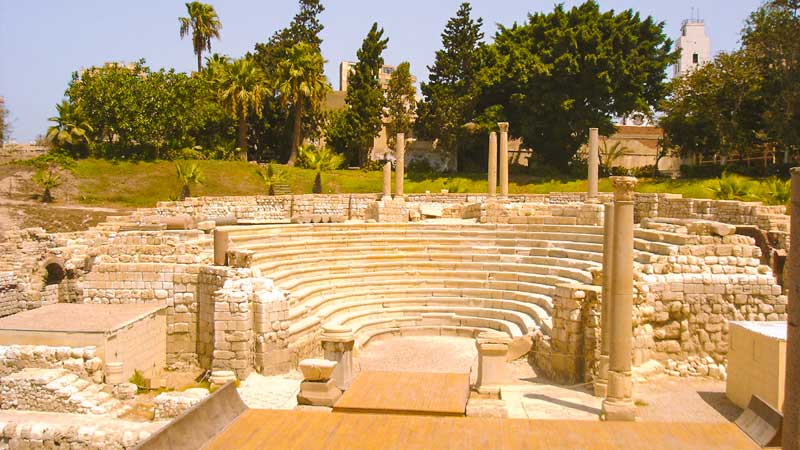
The Roman theater we see today in the city of Alexandria is a typical form of Roman theater, consisting of an audience section made of marble, granite columns, and five compartments based on thick limestone walls. The theater used to host large ceremonies and events with a capacity of 600 spectators.
The audience section consisted of 13 rows of white marble, and the supporting columns were made of granite exported from Aswan in southern Egypt. The five compartments at the top of the audience section were likely to house some royals or public figures during performances. They were covered by dome-shaped ceilings supported by granite columns to protect the audience from the sun and rain. In the 6th century AD.
Roman sites in Egypt
By 31 BC, Egypt felt itself in the hands of the Romans and turned most of Egypt’s essential sites into thriving commercial centers. More than 700 ancient Roman settlements, forts, gold mines, and roads have been marked in Egypt by archaeologists.
Egypt was wholly attracted to the Romans, who were influenced by its traditions and culture. They buried themselves in tombs similar to those of the pharaohs. They covered their necropolises with scenes of Egyptian gods, showing how much they were affected by Egyptian religion.
After the suicide tragedy of Queen Cleopatra, the last pharaoh (of the lineage of Greece), and Mark Antony, Egypt was ruled by enough emperors to leave their fingerprints on the country alongside the Greek monuments that were built by the Ptolemaic family before. Philae and Dendera temples are the best examples of Greece’s location in Egypt alongside the Romans. You can customize your trip under the management of our operations team to include any of these locations in your itinerary.
0 Comment