


The Valley of the Nobles
One of the non-royal necropolises in Egypt is the Valley of the Nobles. The Valley of the Nobles is next to the Valley of the Kings and Queens west of Luxor on the west bank of the Nile River. The nobles’ tombs are distinguished from the royal tombs by their simple decorations inspired by their lives. But the royal tombs are richly decorated from the afterlife. Valley Tombs are referred to by “TT,” which stands for Theban Tomb, followed by the number of the tomb and the name of its owner.
The History of the Valley of the Nobles
The belief of eternity went only to the kings; they were buried with their treasures, food, and everything necessary in life in the Hereafter. From the Middle Kingdom, the belief in eternity began to be the nobles. In the New Kingdom, the nobles had the right to establish their tombs and decorate them like kings. Ministers, priests, army soldiers, and the king’s palace officials were buried there. The Valley was used from the ancient kingdom to the Ptolemaic kingdom, but most of its tombs were from the 18th, 19th, and 20th dynasties.
The Construction of the Valley of the Nobles
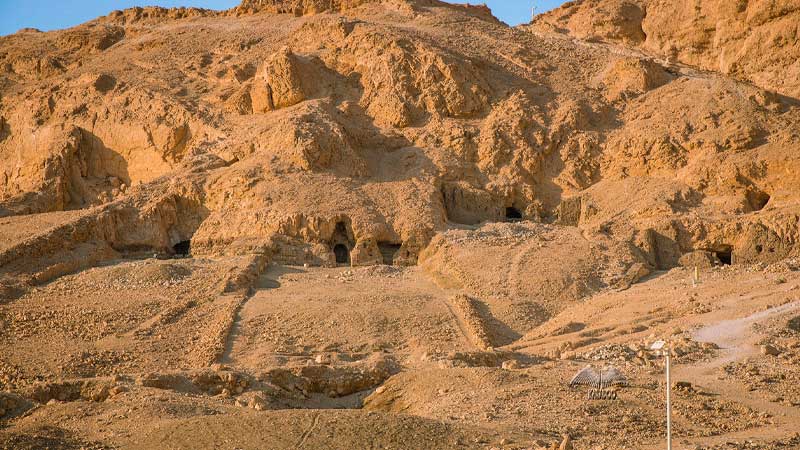
The Valley of the Nobles was carved into the rock, there are more than 400 tombs, but only ten are open to the public. The title and the name of the tomb’s owner were written on the facade of the graves. Funerary cones (clay cones with hieroglyphs bearing the deceased’s name) are sometimes found at the tomb’s entrance. The walls of the graves are decorated with inscriptions of the nobleman’s daily life and funerary scenes. The Valley is divided into six necropolises;
- Dra Abu El-Naga; It houses 150 tombs and is divided into two areas, one with 100 graves from the Middle Kingdom and 60 burials from the New Kingdom (18th and 19th dynasties).
- El-Joja; It houses 50 tombs from the 17th, 19th, and 20th dynasties and three graves from the first intermediate period.
- El-Assasif; South of the cemetery of Dra Abu El-Naga. It houses the tombs of the New Kingdom (18th dynasty) and others from the Third Intermediate Period (25th and 26th dynasties).
- El-Tarif; It is located almost at the entrance to the Valley of the Kings and is considered the oldest area in the Theban necropolis. It houses the tombs of the late Second Intermediate Period, the First Intermediate Period, and the Middle Kingdom.
- Qurnet Murai; It is located near Deir Al Medina. It houses the tombs of the nobles of the New Kingdom (18th, 19th, and 20th dynasties), the Ptolemaic period, and the 26th dynasty.
- Sheikh Abd El-Qurna; houses a few tombs from the 11th and 12th dynasties and 150 graves from the 18th, 19th, and 20th dynasties.
The most famous tombs in the Valley of the Nobles
- The Tomb of Nakht (TT 52); He was Amun’s priest, scribe, and astronomer during the reign of King Tuthmosis IV in the 18th dynasty. His tomb is magnificent, and the first room is like a museum because of its paintings and scenes representing real and daily life.
- The Tomb of Ramose (TT 55); is in the heart of the Sheikh Abd El-Qurna area. Its structure is in the typical style of the 18th dynasty: a descending staircase leads to a courtyard that ends with a corridor leading to an antechamber. From the antechamber, access to another passage leads to a room with eight columns. The walls of the two rooms have been prepared for decorations that are not made, and only the corridors are decorated.
- The Tomb of Menna (TT69); he was a scribe of the fields of Lord of the Gods of Upper and Lower Egypt during the reign of Thutmose IV and Amenhotep III in the 18th dynasty. His tomb is in the shape of a “T” and was excellently decorated and brightly painted. On the walls are drawings depicting Menna, his wife, and his children in their daily life and agricultural work.
- The Tomb of Rejmira (TT100); was the vizier of the 18th dynasty to King Tuthmosis III and Amenhotep II. It is in the shape of a “T.” Still, it is famous for its wall decoration depicting Rejmira’s work and activities, drawings of agriculture and hunting, funeral rites, other trades, and daily life.
- Sennefer’s Tomb (TT 96); He was a prince during the reign of Amenhotep II. His tomb is richly decorated with scenes from the Book of the Dead and depictions of the pharaoh with his wife, Merit. The ceiling of the tomb is painted with bunches of black grapes.
[ Check out our Egypt Vacation Packages & Trips ]
0 Comment