


The Step Pyramid of Djoser ( Zoser)
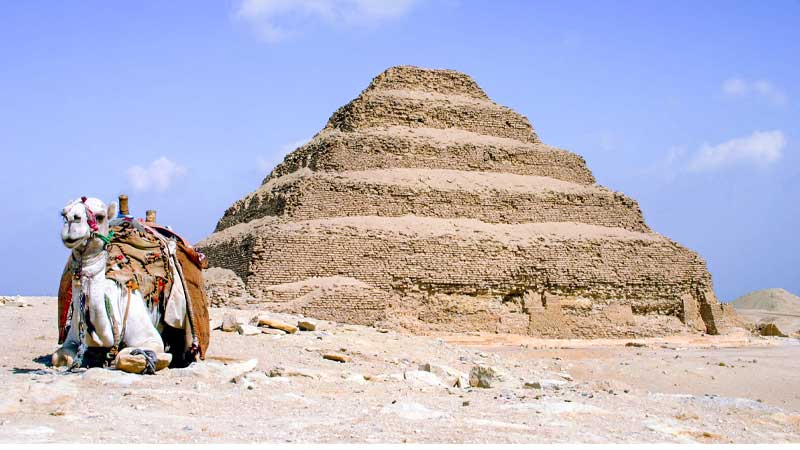
The Pyramids of Giza are the most famous in Cairo. Still, other pyramids, such as the Djoser Step Pyramid in Saqqara, are of great importance and are located in the heart of the Saqqara Complex.
It is 25 km south of Giza, 30 km from Cairo, and west of the ancient capital, Memphis, on the west bank of the Nile River. The steps were meant to symbolize that the King may ascend to heaven to meet Osiris. And other gods, also so that the gods descend to earth.
Booking our Tour Pyramids Tour (Giza Pyramids, Saqqara, Memphis)
The History of the Pyramid of Zoser (Djoser)
The Pyramid of Djoser was built by order of King Djoser in the III dynasty in the XXVII century BC from 2670 to 2650 BC. Its architect is Imhotep (the first architect in Ancient Egypt). The Pyramid of Djoser was known by the name “Dyeser Deyeseru.” It is considered a prototype of the Pyramids of Giza and the other pyramids in Egypt. Before Djoser, royal tombs were underground chambers covered by mastaba (rectangular mud-brick structure). Still, King Djoser’s tomb consisted of six huge mastabas, one on top of another made of stone.
Later all the pharaohs built their tombs in the form of pyramids, but they did not have time to finish them. Seneferu was the first pharaoh to finish his pyramids after Djoser, and his pyramids were already smoothing the Bent Pyramid and the Red Pyramid. In 1821 the blue earthenware chambers and plates were discovered, but more severe excavations began in the 1920s. In 1992 a major earthquake destroyed much of the Pyramid, including the burial shafts and the ceilings of the underground chambers. In 2006, the restoration of the Pyramid began, which lasted until 2020, with a pause from 2011 to 2013. After 14 years of restoration, it was reopened to the public in 2020.
The Construction and Description of the Step Pyramid of Djoser
Imhotep thought of building the Pyramid in such a stepped way so that the King’s soul ascends to heaven. The Step Pyramid was built in several stages. Initially, Imhotep planned to construct a mastaba, but the Pyramid was converted into steps. But from the beginning, it was different from the previous mastabas because of its stone construction.
Djoser Step Pyramid in Saqqara was built of limestone. Mainly they built the base of the Pyramid, which was a square mastaba of 63 m, and its height was eight m. 3m were added to the fourth side, making it a 71m square. Then 8.5 m were added to the east side, converting it to a 71 and 79-meter rectangular and a 33 m deep vertical shaft. Three levels of mastabas were added, and thus there was a 4-level pyramid with a height of 43 m and a rectangular base of 85 m and 77 m. Then it was enlarged by meters on its sides, and two more mastabas were added. Thus was a pyramid of 6 mastabas 62.6 m high and rectangular bases 140 m and 118 m. Currently, the Step Pyramid dimensions are 121 m by 109 m with a height of 60 m. Its size is 330,400 cubic meters.
The last two steps of the Pyramid were built with more than 200 thousand tons of stone. The best view of the Pyramid is from its east side. It was covered by limestone but disappeared by erosion, evident in some parts of the east. The last two steps of the Pyramid were built with more than 200 thousand tons of stone.
The best view of the Pyramid is from its east side. It was covered by limestone but disappeared by erosion, evident in some parts of the east. The last two steps of the Pyramid were built with more than 200 thousand tons of stone. The best view of the Pyramid is from its east side. It was covered by limestone but disappeared by erosion, evident in some parts of the east.
The Interior of the Step Pyramid Djoser
Djoser Step Pyramid in Saqqara has a feature not found in other pyramids, a 28m deep vertical shaft with room for a large granite sarcophagus. This well is covered with a dome. At the end of this vertical shaft is the King’s Chamber which is 7m long and 7m wide at the heart of the Pyramid.
The chamber was built of red granite and enclosed by large granite blocks and is surrounded by a series of underground passageways covering 5.5 km. There are eleven 32 m deep shafts that lead to horizontal passages leading to eleven funerary chambers dedicated to members of the King’s family that initially housed the furniture and artifacts of the deceased, more than 48 thousand ceramic and stone vessels from the dynasties I and II, in addition to the mummies of his family but the King’s mummy was not found.
Check out our Egypt Vacation Packages & Trips
0 Comment